
Education is evolving rapidly in the digital age. Classrooms are no longer limited to chalkboards, textbooks, and traditional lectures. Today, technology is reshaping how students learn and how teachers deliver knowledge. One of the most powerful technologies driving this transformation is Artificial Intelligence (AI).
From personalized learning platforms to automated grading systems, AI in education is changing the way educational institutions operate. Students can now receive customized learning experiences, teachers can analyze student performance faster, and institutions can improve educational outcomes through data-driven insights.
The growing demand for digital learning, especially after global shifts toward online education, has accelerated the integration of AI technologies into schools and universities. As a result, educators, policymakers, and researchers are increasingly exploring how AI can improve teaching efficiency, student engagement, and overall learning effectiveness.
Understanding the role of AI in education is therefore essential for students, teachers, and educational institutions that want to remain relevant in the modern learning environment.
Understanding AI in Education
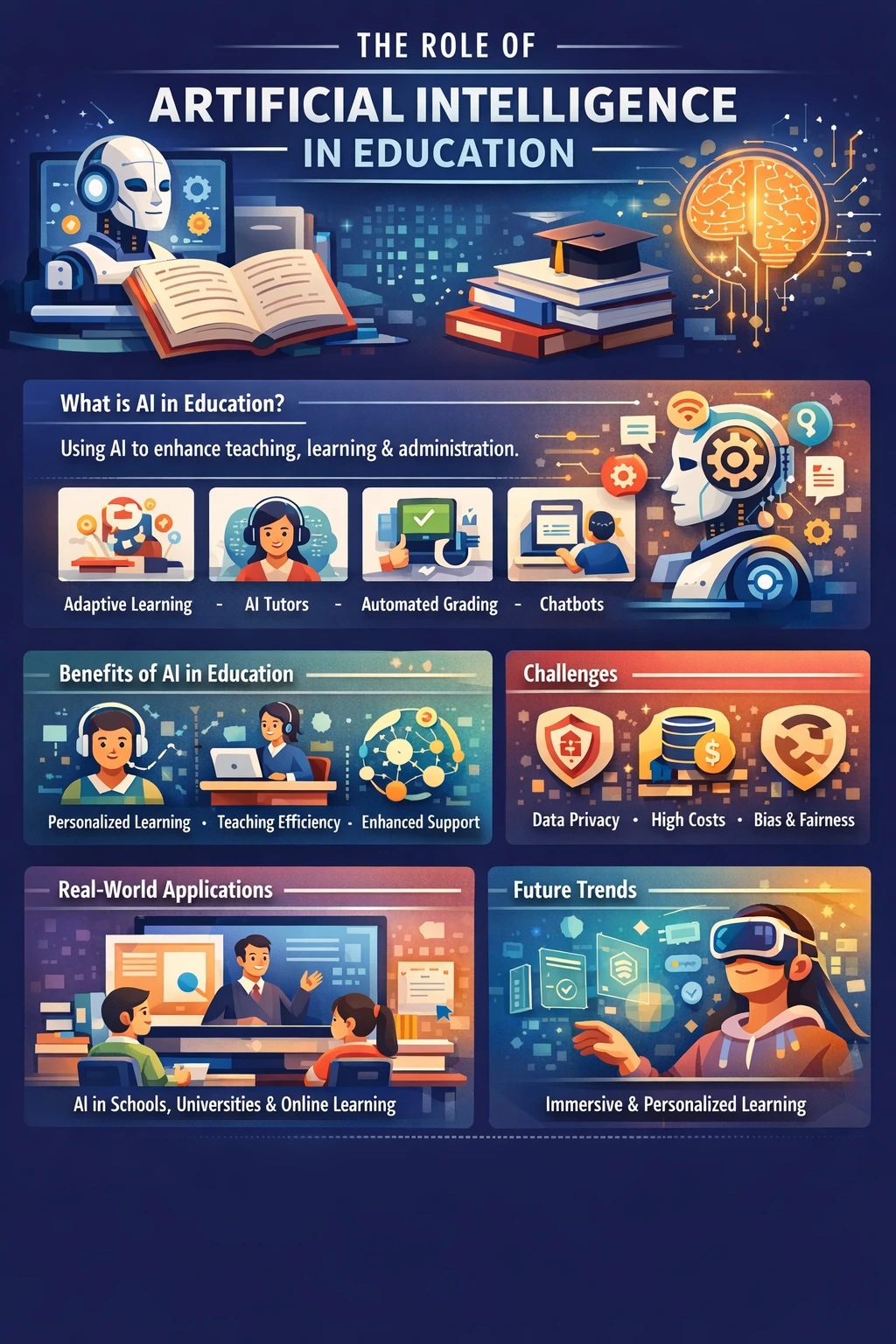
What is AI in Education?
AI in education refers to the use of artificial intelligence technologies to enhance teaching, learning, administration, and student support within educational systems.
Artificial intelligence enables machines and software to simulate human intelligence processes such as:
- Learning from data
- Pattern recognition
- Decision-making
- Natural language processing
In educational contexts, AI systems analyze student behavior, adapt learning content, automate administrative tasks, and provide intelligent tutoring systems.
Key Concepts in AI-Powered Learning
Several technologies form the foundation of AI-based educational tools:
Machine Learning
Algorithms that analyze large amounts of student data to identify patterns and predict learning outcomes.
Natural Language Processing (NLP)
Allows computers to understand and respond to human language, enabling chatbots, AI tutors, and automated feedback systems.
Adaptive Learning Systems
Platforms that adjust course materials and assessments based on individual student progress.
Learning Analytics
The collection and analysis of educational data to improve teaching strategies and learning performance.
Importance of AI in Modern Education
AI is becoming increasingly important in education because it helps address major challenges such as:
- Large classroom sizes
- Diverse learning abilities
- Limited teacher resources
- Need for personalized learning
By leveraging AI technologies, educators can create more inclusive, efficient, and personalized learning environments.
Key Components of AI in Education
AI technologies in education typically include several key components that work together to improve learning outcomes.
1. Intelligent Tutoring Systems
AI-powered tutoring systems provide personalized guidance to students without constant teacher supervision.
Features include:
- Real-time feedback
- Step-by-step problem solving assistance
- Customized learning paths
These systems help students learn at their own pace while reinforcing understanding.
2. Adaptive Learning Platforms
Adaptive learning platforms adjust course content automatically based on student performance.
For example, if a student struggles with a topic, the system may:
- Provide additional practice exercises
- Suggest alternative explanations
- Slow down the learning pace
This ensures students fully understand concepts before progressing.
3. Automated Grading and Assessment
AI systems can grade assignments, quizzes, and even essays quickly and accurately.
Benefits include:
- Reduced workload for teachers
- Faster feedback for students
- Consistent grading standards
4. AI Chatbots and Virtual Assistants
Educational chatbots assist students with questions related to coursework, deadlines, and administrative processes.
Examples of tasks AI chatbots handle:
- Answering student queries
- Providing study reminders
- Offering basic academic support
5. Predictive Analytics
AI can analyze student performance data to identify students at risk of academic failure.
Institutions can then intervene early through:
- Academic counseling
- Additional tutoring
- Personalized learning support
Benefits of AI in Education
The adoption of AI technologies offers numerous advantages for students, teachers, and educational institutions.
Personalized Learning Experiences
One of the greatest benefits of AI is customized learning.
AI systems analyze student learning patterns and adjust content accordingly, ensuring each student receives instruction tailored to their needs.
Benefits include:
- Improved comprehension
- Increased student engagement
- Reduced learning gaps
Improved Teaching Efficiency
AI tools automate repetitive tasks such as grading, scheduling, and data analysis.
This allows teachers to focus more on:
- Teaching
- Mentoring students
- Designing better learning experiences
Enhanced Student Support
AI-powered systems provide students with constant academic assistance, even outside classroom hours.
Students can access:
- AI tutors
- Study recommendations
- Instant feedback
Data-Driven Decision Making
Educational institutions can use AI-generated insights to improve policies, curriculum design, and teaching strategies.
For example:
- Identifying courses with high failure rates
- Monitoring student engagement levels
- Improving academic support programs
Increased Accessibility
AI technologies can make education more inclusive by supporting students with disabilities.
Examples include:
- Speech-to-text tools
- Text-to-speech systems
- AI translation services
Challenges and Limitations of AI in Education
Despite its benefits, AI integration in education also presents several challenges.
Data Privacy Concerns
AI systems rely heavily on student data, which raises concerns about:
- Data protection
- Student privacy
- Ethical use of personal information
Educational institutions must implement strong cybersecurity policies to protect student data.
High Implementation Costs
AI technologies can be expensive to develop and maintain.
Costs include:
- Software development
- Infrastructure upgrades
- Staff training
This makes adoption difficult for some schools and institutions.
Lack of Human Interaction
While AI can support learning, it cannot fully replace human teachers.
Human educators provide:
- Emotional support
- Motivation
- Critical thinking guidance
Over-reliance on AI may reduce valuable human interactions in education.
Algorithm Bias
AI systems may unintentionally reflect biases present in their training data.
This can lead to:
- Unfair assessments
- Biased recommendations
- Inequality in learning opportunities
Real-World Applications of AI in Education
AI technologies are already being implemented in many educational environments around the world.
Smart Learning Platforms
Many online learning platforms use AI to personalize learning experiences.
Features include:
- Personalized course recommendations
- Adaptive quizzes
- Performance analytics
AI-Powered Language Learning
Language learning apps use AI to improve pronunciation, grammar, and vocabulary skills.
These systems provide instant feedback and personalized exercises.
Automated Academic Support
Universities increasingly use AI chatbots to assist students with administrative tasks such as:
- Course registration
- Exam schedules
- Campus services
AI-Based Research Assistance
Researchers use AI tools to analyze large datasets, identify patterns, and generate insights for academic studies.
This accelerates research productivity and innovation.
Practical Tips for Using AI in Education
Educators and students can maximize the benefits of AI by adopting effective practices.
For Teachers
- Integrate AI tools gradually into lesson plans
- Use AI analytics to identify struggling students
- Combine AI tools with traditional teaching methods
For Students
- Use AI-powered learning platforms for personalized study plans
- Take advantage of AI tutoring systems for difficult subjects
- Verify AI-generated information using reliable academic sources
For Educational Institutions
- Invest in teacher training for AI technologies
- Implement strong data privacy policies
- Encourage responsible and ethical AI use
Future Trends in AI in Education
The future of AI in education is expected to bring even more innovation and transformation.
AI-Powered Personalized Universities
Universities may soon offer fully customized degree programs tailored to individual learning goals and career paths.
Immersive Learning with AI and Virtual Reality
AI combined with virtual and augmented reality could create immersive learning experiences where students interact with virtual environments.
Examples include:
- Virtual science laboratories
- Historical simulations
- Interactive medical training
AI-Powered Career Guidance
Future AI systems may analyze student interests, skills, and performance to recommend suitable career paths.
Intelligent Curriculum Design
AI may help institutions design curricula based on labor market trends and skill demands.
Conclusion
Artificial intelligence is rapidly transforming the global education landscape. From personalized learning experiences to automated administrative processes, AI in education is helping institutions improve efficiency, accessibility, and student outcomes.
While challenges such as data privacy, cost, and ethical concerns remain, the potential benefits of AI are too significant to ignore. By combining AI technologies with effective teaching strategies, educators can create more engaging, inclusive, and adaptive learning environments.
As technology continues to advance, the integration of AI in education will likely become even more widespread, shaping the future of learning for generations to come.
Frequently Asked Questions (FAQs)
1. What is AI in education?
AI in education refers to the use of artificial intelligence technologies to improve teaching, learning, assessment, and educational administration.
2. How does AI benefit students?
AI helps students by providing personalized learning experiences, instant feedback, adaptive learning paths, and access to AI-powered tutoring systems.
3. Can AI replace teachers in the classroom?
No. AI is designed to support teachers, not replace them. Human educators remain essential for mentorship, emotional support, and critical thinking development.
4. What are examples of AI tools used in education?
Examples include adaptive learning platforms, AI tutoring systems, automated grading tools, educational chatbots, and learning analytics systems.
5. What are the risks of using AI in education?
Potential risks include data privacy issues, algorithm bias, high implementation costs, and reduced human interaction in learning environments.